Wine and Beer Storage Guide: Apartment, House, and Serious Collector Solutions
|
THE SHORT ANSWER Wine and beer both suffer from the same four enemies: heat, light, vibration, and humidity swings. The difference is urgency. A bottle of Pinot Noir stored badly loses years off its life over months. An IPA stored badly loses the whole point of the beer in weeks. Getting storage right is not about having a wine cellar. It is about understanding what kills the bottle and removing those things from the equation, whatever space you have. |
|
KEY TAKEAWAYS ◆ The ideal wine storage temperature is 55 degrees Fahrenheit. Anything consistently above 70 degrees accelerates aging and eventually cooks the wine. ◆ Temperature swings are more damaging than a stable temperature that is slightly off. A wine stored at 60 degrees consistently does far better than one that swings from 50 to 70. ◆ Most craft beer should be drunk fresh. IPAs are best within 60 to 90 days of canning. Barrel-aged stouts, barleywines, and strong sours can improve with one to three years of proper cellaring. ◆ UV light degrades wine and causes “light strike” in beer, producing a skunky off-flavor within hours of exposure. Dark glass and UV-blocking refrigerator doors are not optional. ◆ You do not need a wine cellar. A thermoelectric countertop unit under $150 handles 12 to 18 bottles and solves 90 percent of the apartment storage problem. ◆ Humidity between 50 and 70 percent keeps corks from drying out. Below 50 percent and air gets into the bottle over time. This matters most for wines you are aging more than a few years. |
In This Article
- Why storage matters more than most people think
- The four enemies of wine and beer
- Level one: the apartment and small space solution
- Level two: the modest house and dedicated unit
- Level three: the serious collector
- Beer storage: what most people get wrong
- Quick rules for every level
- Frequently asked questions
- Sources
Why Storage Matters More Than Most People Think
Wine is alive in a way that most beverages are not. From the moment it is bottled, chemical reactions continue inside the glass. Tannins polymerize, acids mellow, fruit evolves into something more complex, and in a great bottle, all of this happens in a way that makes the wine more interesting with time. The right storage conditions let that process happen on its own schedule. The wrong ones accelerate it, distort it, or stop it entirely.
The stakes are higher than most casual drinkers realize. A bottle of mid-level Cabernet stored above 75 degrees for a summer does not just age faster. It cooks. The fruit turns jammy, the structure collapses, and what should have been a balanced wine in three years becomes flat and flabby in one. A bottle stored in a window suffers light damage that is irreversible within hours of exposure. A bottle stored next to a washing machine vibrates constantly, disrupting the sediment and chemical equilibrium that makes aging possible.
Beer is more forgiving in some ways and less in others. Most craft beer is designed to be drunk within weeks or months of packaging. The hop compounds that give an IPA its character begin degrading almost immediately after canning. A fresh New England IPA is juicy and aromatic. The same beer three months past its canning date is a different beer entirely. On the other end of the spectrum, a well-made imperial stout or barleywine stored properly at cellar temperature for two years will often be better than when it was packaged. Getting storage right for beer means understanding which category each bottle falls into.
The Four Enemies of Wine and Beer
Everything in storage science comes back to four variables. Control them and the rest takes care of itself.
Heat. The ideal long-term wine storage temperature is 55 degrees Fahrenheit. Anything consistently above 65 degrees accelerates aging. Above 75 degrees the wine is in trouble. The chemistry that makes a good wine improve with age requires slow, cool conditions. Heat speeds up those reactions until the wine essentially burns through its development window and comes out the other side as something tired and flat. For beer, heat is equally damaging, particularly for hop-forward styles. IPAs and pale ales stored warm oxidize quickly, producing a papery or cardboard note that brewers call staling.
Temperature swings. This is the one most people underestimate. A wine cellar held at 58 degrees is good. A wine cellar that swings from 50 to 70 degrees seasonally is worse than a basement held at 62 degrees consistently. The expansion and contraction of the liquid inside the bottle puts stress on the cork with every cycle, eventually allowing small amounts of oxygen in and air out. Consistency matters more than hitting an exact number.
Light. UV radiation triggers a chemical reaction in wine that produces compounds similar to those in a skunk’s spray. This is called light strike and it is irreversible. It can happen in hours with direct sunlight and over days or weeks with fluorescent lighting. Dark glass provides some protection, which is why most quality wine comes in dark green or amber bottles. Clear glass provides almost none, which is why Champagne stored in direct light goes off faster than you expect. For beer, light strike is well documented and even faster-acting. It is why craft beer increasingly comes in cans rather than clear or green glass bottles.
Vibration. This one is subtle and slower-acting than the others, but it is real. Constant vibration disturbs the sediment in aging wines and interferes with the slow chemical reactions that make aging possible. Storing wine on top of a refrigerator, next to a washer or dryer, or above a subwoofer all introduce vibration. Quality wine fridges use thermoelectric cooling rather than compressors precisely because compressors vibrate. For shorter-term storage of a few months, vibration is a minor concern. For wines you are cellaring for years, it matters.
Level One: The Apartment and Small Space Solution
The challenge at this level is not money. A good countertop wine fridge costs less than two bottles of decent Burgundy. The challenge is space and the temptation to do nothing, which means bottles sitting on the kitchen counter next to the stove, standing upright in a cabinet, or rotating in and out of a refrigerator that is too cold and too dry for anything beyond a week or two.
The refrigerator problem is worth understanding. A standard kitchen refrigerator runs at 35 to 38 degrees Fahrenheit and very low humidity. That is fine for a bottle you are opening tonight. For anything you are keeping more than a few days, the cold dries out the cork, the low humidity accelerates that process, and the food odors in the fridge find their way in through the cork. Wine stored in a kitchen refrigerator for more than two weeks begins to suffer. White wine suffers more slowly than red. Sparkling, with its sealed cap, is more tolerant. But none of them thrive there.
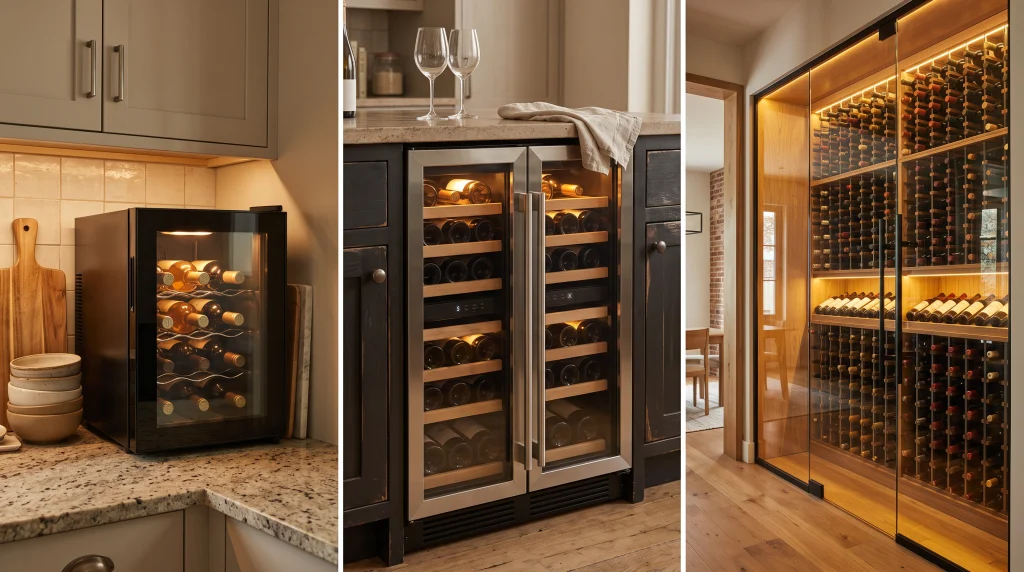
The solution at this level is a thermoelectric countertop unit. Thermoelectric cooling has no compressor, which means no vibration and very low noise. The units are small enough to sit on a counter or in a cabinet, and they hold temperature well enough for bottles you will be drinking within one to three years.
| Unit | Capacity | Price | Best For |
|---|---|---|---|
| Ivation 8-Bottle Thermoelectric | 8 bottles | ~$80 | The true apartment starter. Nearly silent, UV-resistant glass, vibration-free. Fits on a counter with room to spare. |
| Schmecke 12-Bottle Thermoelectric | 12 bottles | ~$120 | Narrow footprint, tinted UV-protective glass, LED lighting. Quiet enough for a bedroom corner. |
| Koolatron 12-Bottle Dual Zone | 12 bottles | ~$130 | Two zones of six bottles each. Serve reds at one temp and whites at another. Best value at this size for someone storing both. |
| NewAir Compact 23-Bottle | 23 bottles | ~$150 | Stepping-stone unit between the compact and mid-size tiers. UV-protected double-pane glass, digital thermostat. Good for someone who buys by the case. |
|
APARTMENT RULES Store bottles on their side so the wine stays in contact with the cork. Keep the unit away from the stove, dishwasher, and any direct sunlight. Set the temperature to 55 degrees for a mix of red and white. If you have a dual-zone unit, run reds at 55 to 60 and whites at 45 to 50. Do not store sparkling wine in a thermoelectric unit for more than a few weeks unless it has a zone that holds 40 to 45 degrees. |
Level Two: The Modest House and Dedicated Unit
At this level the collection has grown past a case or two. There is probably a mix of wines you are drinking now, wines you are aging for a year or two, and a few bottles you bought specifically to hold for a special occasion. A countertop unit is no longer enough. The question becomes whether to buy a dedicated under-counter or freestanding unit, or to convert a closet or basement corner into a simple cellar.
The dedicated unit is easier and more reliable for most people. A good mid-size dual-zone fridge in the $350 to $500 range holds 30 to 50 bottles, runs quietly, and maintains consistent temperature better than a basement corner that swings with the seasons. The dual-zone feature is the key upgrade at this level: reds at 55 to 60 degrees, whites and sparkling at 45 to 50 degrees, in the same unit.
| Unit | Capacity | Price | Best For |
|---|---|---|---|
| Schmecke 33-Bottle Dual Zone | 33 bottles | ~$380 | Best value at this tier. Digital controls, UV-resistant double-pane glass, adjustable racks. Good for a mix of reds, whites, and a few special bottles. |
| NutriChef PKCWC24 French Door | 24 bottles | ~$355 | Dual-door design means you open only the zone you need, minimizing temperature disruption. Polished chrome racks, built-in fan for air circulation. Best for someone storing reds and whites separately. |
| NewAir Shadow Series 33-Bottle | 33 bottles | ~$400 | Sleek design, quiet compressor, good for a dining room or kitchen. The step up from Schmecke if aesthetics matter as much as performance. |
If a basement corner or spare closet is available, a DIY approach can be more cost-effective for larger collections. The requirements are simple: consistent temperature between 55 and 65 degrees, humidity between 50 and 70 percent, no direct light, and isolation from vibration. A cool interior closet away from exterior walls often works. Add a small humidifier if needed and a thermometer-hygrometer to monitor conditions. The investment is minimal; the main risk is seasonal temperature variation that a unit would handle automatically.
|
THE REAL-WORLD CAPACITY RULE Wine fridge manufacturers count capacity in standard Bordeaux bottles. If your collection includes Burgundy bottles, Champagne bottles, or magnums, actual capacity is typically 65 to 75 percent of the stated number. A 33-bottle unit realistically holds 22 to 25 bottles of mixed formats. Buy slightly larger than you think you need. |
Level Three: The Serious Collector
At this level the collection numbers in the hundreds of bottles, some of which are being held for five, ten, or fifteen years. The economics shift: the cost of a proper storage unit is small compared to the value of what it protects. A single bottle of aged Burgundy or a vertical of Napa Cabernet represents an investment that a consumer-grade unit can maintain only imperfectly.
The key features at this level are compressor quality, humidity control, UV glass, and vibration dampening. Cheap compressors cycle on and off frequently, creating temperature swings within the unit. Quality compressors run more consistently and with less vibration. Humidity management becomes critical for wines aging a decade or more. And label visibility matters once a collection reaches 100 or more bottles: being able to read labels without pulling bottles is a practical concern.
| Unit | Capacity | Price Range | Best For |
|---|---|---|---|
| Wine Enthusiast Classic 250-Bottle Wine Vault | 250 bottles | ~$1,200 | The entry point for serious collection storage. Full-size freestanding cabinet, dual zone, UV glass. Good for a collector moving from a mid-size unit. |
| Wine Enthusiast VinoView 155 Smart Wi-Fi | 155 bottles | ~$1,440 | Patented label-forward matrix shelving so you can read every bottle without pulling it. Wi-Fi monitoring via app. For the collector who wants to manage the cellar from their phone. |
| LeCavist Dual Zone 226-Bottle | 226 bottles | ~$2,500 | Advanced temperature control, no-frost system, high-efficiency compressor. The serious step up from consumer-grade units. Built to age wine long term. |
| EuroCave La Premiere | 100 to 177 bottles | ~$3,500+ | The benchmark for serious collectors. Maintains humidity over 50 percent, touchscreen with visual alarms, beechwood shelves, designed specifically for long-term aging. An investment, not an appliance. |
|
WHEN TO CONSIDER PROFESSIONAL STORAGE If your collection includes bottles worth several hundred dollars each and you are holding them for a decade or more, a professional wine storage facility is worth serious consideration. Temperature and humidity are professionally maintained, insurance is available, and the conditions are optimal in ways that even a high-end home unit cannot match. The cost runs $20 to $50 per case per year. For a collection worth $20,000 or more, that is a small insurance premium. |
Beer Storage: What Most People Get Wrong
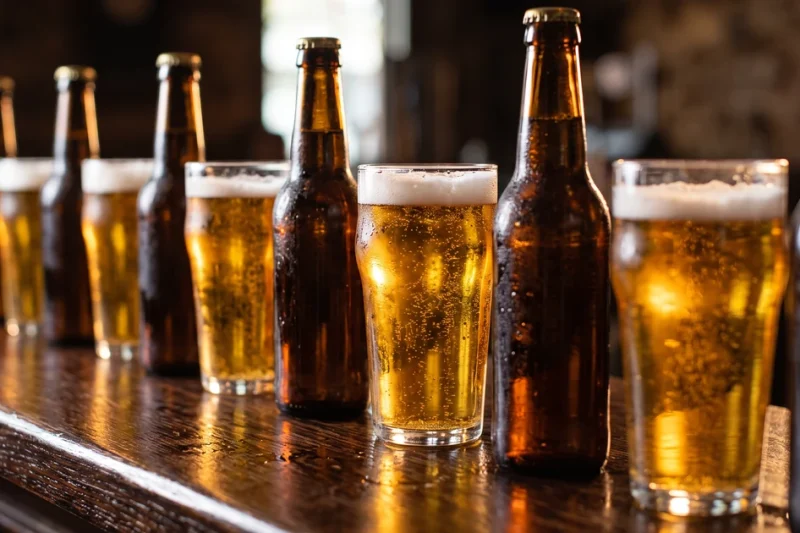
The biggest mistake in craft beer storage is treating all beer the same way. Most craft beer is designed to be consumed fresh. A few styles genuinely improve with age. Getting this wrong in either direction is a waste: drinking an imperial stout the day you buy it means missing two years of potential development, while cellaring a New England IPA for six months means drinking a shadow of what it was.
Drink these fresh. IPAs of all kinds, pale ales, wheat beers, session beers, most lagers, and fruited sours. Hop compounds degrade quickly. An IPA is at its best within 60 to 90 days of canning. Many breweries put a “canned on” date on the package rather than a “best by” date, which is a more honest way of expressing the same thing. If a hoppy beer does not have a date, ask. If it has been on the shelf for six months, leave it.
These can age. Imperial stouts, barleywines, strong Belgian ales, traditional Flemish sours, and double IPAs with very high alcohol can improve with one to three years of proper cellaring. The alcohol and malt structure give them resilience. The flavors integrate, the rough edges soften, and the complexity deepens. Store these at 55 degrees in the dark, upright (most craft beer has no sediment that benefits from horizontal storage), and check them annually.
| Style | Store Fresh or Age? | Optimal Window | Storage Temp |
|---|---|---|---|
| New England IPA | Fresh only | Within 4 to 6 weeks of canning | 35 to 38 degrees (refrigerated) |
| West Coast IPA | Fresh only | Within 60 to 90 days of canning | 35 to 38 degrees (refrigerated) |
| Imperial Stout | Age | 1 to 3 years from packaging | 55 degrees, dark, upright |
| Barleywine | Age | 2 to 5 years from packaging | 55 degrees, dark, upright |
| Belgian Quad / Strong Ale | Age | 1 to 3 years from packaging | 55 degrees, dark, upright |
| Flemish Red / Lambic | Age | 2 to 5 years from packaging | 55 degrees, dark, upright |
| Pilsner / Lager | Fresh only | Within 90 days of packaging | 35 to 38 degrees (refrigerated) |
Quick Rules for Every Level
Regardless of how much space you have or how large your collection is, these rules apply at every tier.
Store wine on its side. The horizontal position keeps the wine in contact with the cork, preventing it from drying out and allowing air in. Screw-cap wines and sparkling wines with crown caps can stand upright without consequence, but the habit of storing everything on its side is a good one.
Keep the temperature consistent. Pick a target and hold it. 55 degrees is ideal; 58 to 62 degrees is acceptable. What is not acceptable is a space that runs 55 degrees in winter and 72 degrees in summer.
Block the light. Even indirect artificial light causes long-term damage to wine. UV-filtering glass on a wine fridge, a dark closet, or a basement away from windows all serve the same function.
Manage humidity. 50 to 70 percent relative humidity protects corks. Below 50 percent you risk cork shrinkage over time. Above 70 percent you risk mold on labels and cases. A simple digital hygrometer costs under $15 and tells you exactly where you stand.
Keep beer cold and drink it fresh unless it is specifically worth aging. Most craft beer is not. The exceptions, listed above, are worth identifying and setting aside at cellar temperature. Everything else goes in the fridge and comes out within the window printed on the package.
Frequently Asked Questions
Can I store wine in a regular refrigerator?
For a few days before opening, yes. For anything longer, a standard refrigerator is too cold, too dry, and full of food odors that can penetrate the cork over time. Wine stored in a kitchen refrigerator for more than two weeks begins to suffer. White wine handles it better than red. Sparkling, with its sealed cap, is the most tolerant but still not ideal beyond a month or two.
What temperature should I serve red wine?
Cooler than most people think. Red wine is best served at 60 to 65 degrees, not room temperature. If your house runs 70 to 72 degrees, the wine on your counter is already too warm. Twenty minutes in the refrigerator before serving brings a red to the right temperature. Light reds like Beaujolais, Pinot Noir, and Barbera benefit from being served even cooler, around 55 to 58 degrees.
Does beer need to be stored on its side?
No. Unlike wine, most craft beer does not benefit from horizontal storage. The exception is bottle-conditioned beers with live yeast, where horizontal storage is sometimes recommended to keep the yeast evenly distributed. For most canned and bottled craft beer, upright storage is preferable because it limits the beer’s surface contact with any oxygen present in the headspace.
How long can I keep an unopened bottle of wine?
It depends entirely on the wine. An inexpensive table wine is best within one to three years of vintage. A mid-range Cabernet or Bordeaux blend is at its best between three and ten years. A serious Burgundy or Napa Cabernet can peak at ten to twenty years or beyond. The key is storing it properly throughout. A wine held at the wrong conditions for three years will not benefit from proper storage in year four.
What is the best wine fridge for under $200?
The Koolatron 12-Bottle Dual Zone at around $130 is the best value under $200 for someone storing both reds and whites. The Schmecke 12-Bottle Thermoelectric at around $120 is the best single-zone option for the price, particularly for reds. Both use thermoelectric cooling, which means no vibration and very low noise.
How do I know if a beer is worth cellaring?
The two key indicators are ABV and style. Any beer above 8 percent ABV in a style designed for malt complexity (imperial stout, barleywine, Belgian quad, strong sour) is a candidate for cellaring. The high alcohol preserves the beer and allows the flavors to integrate over time. Any hoppy beer regardless of ABV should be drunk fresh. If the brewery intended the beer for aging they will usually say so on the label or their website.
Can I convert a closet into a wine cellar?
Yes, with some important caveats. The closet needs to maintain a consistent temperature between 55 and 65 degrees, have no direct light source, hold humidity between 50 and 70 percent, and be isolated from vibration. An interior closet away from exterior walls often works in temperate climates. In hot climates or in spaces that fluctuate seasonally, a dedicated unit will outperform a DIY closet. A digital thermometer-hygrometer installed inside tells you whether the conditions are within range.
A note on pricing: Prices listed are suggested retail and will vary by retailer and region. CrushBrew recommends shopping around — Wine-Searcher, Total Wine, and your local independent shop will often beat the numbers shown here.
Sources
- Wine Guardian: Wine Storage 101
- VinePair: Beer Aging Guide
- Chowhound: Why Temperature Is Key for Storing Craft Beer
- Choice Wineries: Best Small Wine Fridges
- Averie Cooks: Best Dual Zone Wine Fridges
- Invintory: Best Wine Fridges for Collectors 2026
- Rosehill Wine Cellars: Managing Temperature, Humidity, and Vibrations