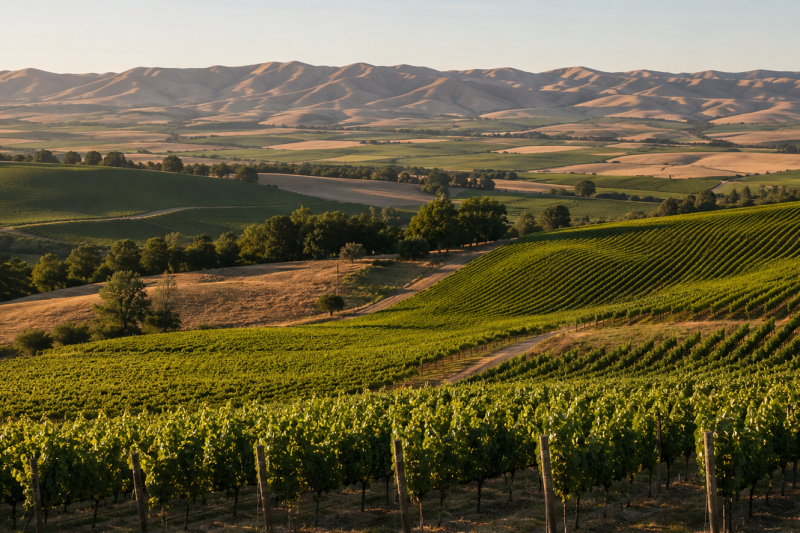
Most American wine drinkers could name five California regions before they could name one from Canada. That’s a significant oversight. British Columbia’s Okanagan Valley sits at the 50th parallel — the same latitude as Champagne and Burgundy — but unlike those northern French regions, it bakes in up to 2,000 hours of annual sunshine and barely eight inches of rain. The result is a high-desert wine region of genuine originality: ripe, concentrated, and naturally acidic, producing Pinot Noir, Riesling, Merlot, Syrah, and Chardonnay that compete with the best of the American Pacific Northwest at prices that haven’t yet caught up with the quality. If the Okanagan were in California, it would already be famous. The fact that it’s in Canada is your advantage — for now.
◆The Okanagan is Canada’s most important wine region — and one of North America’s most underrated — Over 200 wineries across 250 kilometres of lake-dotted, desert-flanked valley. Dramatic lake views, mountain backdrops, world-class tasting experiences, and wines that regularly earn international recognition. Most Americans have never heard of it. That gap is closing.
◆Same latitude as Champagne — completely different climate — The 50th parallel usually means cool, marginal wine growing. In the Okanagan, the Cascade Mountains block Pacific moisture and create a high-desert microclimate: hot summer days, dramatically cool nights, ancient glacial soils, and a temperature swing that preserves natural acidity in fully ripe grapes. The same mechanism that makes Paso Robles and Washington State great wine country at work in Canada.
◆The South Okanagan is where the boldest wines are — Oliver, Osoyoos, and the Naramata Bench produce BC’s most concentrated reds — Merlot, Syrah, Cabernet Franc — in Canada’s only true desert climate. The Black Sage Bench and Golden Mile are the sub-regions that produce wines comparable to the best of Washington State’s Yakima Valley.
◆BC produces some of North America’s finest ice wine — The Okanagan’s cold winters and late-hanging grapes create ideal conditions for ice wine production — grapes left on the vine until they freeze naturally, then pressed while still frozen to concentrate sugar and acidity. BC ice wine was first produced in 1972 and the region has been refining the style ever since.
◆The 2025 and 2026 vintages are the ones to seek out — A brutal cold snap in January 2024 devastated nearly the entire BC grape crop — one of the most damaging frost events in the region’s history. The good news: the valley bounced back strongly. The 2025 vintage is being described as lovely and 2026 is shaping up well. Every winery on the Okanagan trail is open and pouring.
In This Guide
Why British Columbia Wine — The Case for Going North
The Okanagan Valley earned serious international attention slowly and then all at once. For decades it was Canada’s best-kept wine secret — a playground for BC residents who knew what was hidden in the valley, while the rest of North America was looking south and west for serious wine. That began to change in the 2010s when Okanagan producers started appearing on international competition podiums, restaurant wine lists outside of Canada, and in the cellar notes of collectors who’d discovered that the quality gap between the Okanagan and more famous Pacific Northwest regions was narrowing fast.
The practical case: BC wine is still priced below its quality level relative to California, Oregon, and Washington equivalents. The experience case: the Okanagan combines world-class wine with a landscape — desert mountains, turquoise lakes, orchards and vineyards running side by side, bear and elk visible from tasting room patios — that has no real equivalent in American wine country. And the discovery case: you will meet winemakers who know your name by your second visit and whose wines you won’t find in any shop south of the border.
The Terroir — Desert, Lakes, and Glacial Soils
What Makes the Okanagan Work as a Wine Region
The rain shadow: The Cascade Mountains block Pacific moisture from reaching the Okanagan Valley, creating an arid continental climate with only 6 to 8 inches of annual rainfall. Almost all vineyards are irrigated from Okanagan Lake and the river system — the same situation as Washington State’s Columbia Valley. The dry conditions suppress disease pressure and concentrate flavor in the fruit.
The lakes: Okanagan Lake — 135 kilometres long and up to 232 metres deep — acts as a massive thermal battery: storing summer heat and releasing it slowly through autumn, extending the growing season and moderating frost risk. The lake-facing slopes on both the east and west sides of the valley are the most coveted vineyard sites, particularly for whites and Pinot Noir.
The soils: Ancient glacial activity left a complex mosaic of sand, gravel, silt, clay, and volcanic rock across the valley floor and benches. The benchlands — elevated terraces above the valley floor — offer well-drained, mineral-rich soils that produce wines of concentration and complexity. In the south, the soils become sandier and warmer, driving the riper, more powerful red wine styles that the Oliver and Osoyoos sub-regions are known for.
The diurnal swing: Summer days reach 35–40°C; nights drop dramatically, sometimes 20°C or more. Grapes ripen fully in the heat, then cool sharply at night — preserving the natural acidity that keeps BC wines fresh and age-worthy rather than flat and overripe.
North Okanagan — Aromatic Whites and Cool-Climate Elegance
The northern end of the Okanagan Valley — Lake Country, Vernon, and the slopes above the north end of Okanagan Lake — is the coolest sub-region and the home of BC’s finest aromatic whites. Riesling, Pinot Gris, Gewürztraminer, and Pinot Blanc perform with particular elegance here, and sparkling wine production is establishing a significant foothold on the cooler north-facing slopes.
Gray Monk Estate Winery in Lake Country was one of the first to plant Pinot Gris in British Columbia — a decision that helped establish the variety as one of the region’s signatures. Sitting high above Okanagan Lake with sweeping views from its deck, Gray Monk is the most established destination in the north and the reference point for BC aromatic whites. Martin’s Lane Winery — part of the larger Mission Hill group but operated with unusual independence — focuses exclusively on Pinot Noir and Riesling from its dramatic hillside tasting room, using 100% gravity flow design and native yeast ferments at 2,000 case production. The Rieslings from Tantalus Vineyards, sourced from one of the oldest vineyard sites in BC, are consistently among the finest expressions of the variety produced anywhere in Canada.
Kelowna — BC’s Wine Hub
Kelowna is the Okanagan’s largest city and its wine capital in the practical sense — the central base for most visitors, with tasting rooms along Lakeshore Road ranging from boutique family operations to grand estate wineries with full restaurants, culinary programs, and architectural ambition that rivals Napa.
Mission Hill Family Estate is the region’s most iconic property — a winery built to make an architectural statement, with a dramatic bell tower, manicured gardens, sweeping Okanagan Lake views, and an on-site fine dining restaurant. It is unabashedly grand and earns the grandeur: the wines, particularly the Reserve and Legacy tiers, are consistently among BC’s finest. Quails’ Gate Estate Winery is the other Kelowna landmark — the Old Vines Restaurant is one of the Okanagan’s most acclaimed dining experiences, and the Old Vines Foch (made from one of BC’s oldest surviving red wine plantings) is a piece of regional history in a glass. CedarCreek Estate Winery, recently reimagined under new ownership and winemaker Taylor Whelan, is producing some of the most exciting Pinot Noir in BC from its East Kelowna Slopes vineyard — wines of genuine Burgundian restraint and precision in a region not always associated with either.
Naramata Bench — Boutique Country
The Naramata Bench is a narrow strip of east-facing benchland above the east shore of Okanagan Lake between Penticton and Naramata — approximately 15 kilometres of some of the most densely planted and most varied wine country in BC. It is concentrated, personal, and almost entirely composed of small-production boutique wineries accessible via a single winding road that connects them without the driving distances that define the rest of the valley.
The Bench’s combination of east-facing aspect, lake influence, and well-drained benchland soils produces a distinctive style: more elegant and restrained than the warmer South Okanagan, with whites that show particular precision and reds that lean toward structure rather than power. Laughing Stock Vineyards’ Portfolio red blend and their Blind Trust whites are Bench signatures. Poplar Grove’s legacy Cabernet Franc has helped define the style of the variety in BC. La Frenz Estate makes Rhône-style blends and whites of consistent quality. The Bench is the Okanagan at its most intimate and most walkable — rent a bicycle and ride between the tasting rooms.
South Okanagan — Oliver, Osoyoos, and Canada’s Only Desert
The South Okanagan is where BC wine gets serious about reds. Oliver — known as the Wine Capital of Canada — and Osoyoos, at the US border, sit in Canada’s only true desert: an extension of the Great Basin Desert that stretches from Mexico north through Nevada, Idaho, and Washington before ending at Osoyoos. The climate is the most extreme in the region — summer temperatures regularly exceed 38°C — and the wines reflect it: bold, concentrated, full-bodied reds that compete with the best of Walla Walla and Paso Robles.
South Okanagan — The Two Benches Worth Knowing
Black Sage Bench — The warmest and most arid section of the Okanagan, on the east side of the valley above Oliver. Deep sandy soils, maximum sun exposure, and extreme heat produce BC’s most powerful and concentrated reds: Merlot, Syrah, Cabernet Franc, Cabernet Sauvignon, and Petit Verdot at a scale of ripeness rarely achieved this far north. Burrowing Owl Estate Winery — with its renowned guesthouse and restaurant — is the landmark producer. Black Hills Estate Winery’s Nota Bene (a Bordeaux blend) is one of BC’s most collected red wines.
Golden Mile Bench — On the west side of the valley above Oliver, the Golden Mile Bench received its own Geographic Indication in 2015 — the first sub-GI within the Okanagan DVA. The soils here are rockier and more mineral than the Black Sage Bench, producing wines with more structure and complexity alongside the ripeness. Hester Creek Estate Winery, with its on-site Terrafina restaurant and vineyard accommodation, is the Golden Mile’s most complete destination experience.
Nk’Mip (pronounced “Ink-a-meep”) Cellars in Osoyoos holds the distinction of being the first Indigenous-owned and operated winery in North America — a milestone for both BC wine and for Indigenous business development in Canada. The wines, made from Osoyoos Indian Band estate vineyards in Canada’s hottest growing region, are serious: the Qwam Qwmt (meaning “achieving excellence”) Syrah and Merlot are benchmarks for the South Okanagan style.
Similkameen Valley — BC’s Organic Wine Secret
West of the Okanagan, accessible via the spectacular Crowsnest Highway through the Cascade Mountains, the Similkameen Valley is BC’s most rugged and most organically committed wine region. The valley is narrower, more dramatic, and less visited than the Okanagan — which is precisely its appeal. The producers here operate largely on their own terms: small production, organic and biodynamic farming, minimal intervention winemaking.
The Similkameen’s extreme diurnal temperature swings — even more pronounced than the Okanagan’s — produce wines of vivid acidity and freshness that complement the organic farming philosophy. Clos du Soleil produces Bordeaux-inspired blends and aromatic whites that consistently rank among BC’s finest. Cerqueira Estate, Orofino Vineyards, and Blind Creek are other producers demonstrating that the Similkameen, while tiny in vineyard area, punches well above its weight in quality and distinctiveness. For visitors willing to make the drive — about 30 minutes west of Oliver — the Similkameen offers the kind of undiscovered wine experience that the Okanagan provided twenty years ago.
What BC Grows — Varieties and Styles
British Columbia’s Key Varieties — What to Drink
Pinot Noir — BC’s most exciting red variety and increasingly the one generating the most international attention. The cooler north and the Naramata Bench produce elegant, Burgundian expressions; the warmer South Okanagan produces fuller, more structured versions. CedarCreek, Tantalus, Martin’s Lane, and Blue Mountain are the producers generating the most critical interest.
Merlot — BC’s most planted red variety and a regional strength, particularly from South Okanagan sites. BC Merlot at its best is fuller and more structured than the soft, approachable version of the variety produced in warmer climates — closer to a Right Bank Bordeaux in weight and texture than to a soft everyday table wine. Burrowing Owl and Nk’Mip produce the benchmark South Okanagan expressions.
Syrah — The South Okanagan’s most exciting emerging red variety. The extreme heat of the Black Sage Bench and Osoyoos produces Syrah of genuine concentration and peppery character — closer to the Northern Rhône in structure than to the warmer-climate Australian Shiraz style. Still an emerging category but producing bottles that turn heads.
Riesling — BC’s most important white variety in terms of quality and potential. The North Okanagan and the lake-influenced central valley produce Rieslings of genuine precision — dry to off-dry, mineral, and age-worthy. Tantalus Vineyards from their old vine sites is the benchmark. These wines are significantly undervalued relative to German and Alsatian equivalents.
Pinot Gris — More widespread than in most North American regions, and produced in a range of styles from crisp and aromatic to fuller, more textured expressions. Gray Monk pioneered the variety in BC; the best examples now come from the cooler north and the Naramata Bench.
Cabernet Franc — Finding a compelling home in BC’s South Okanagan, where it produces wines with the herbal, violet, and dark fruit character of the Loire Valley but with more body and ripeness. Poplar Grove and Burrowing Owl produce the most celebrated expressions. Also appearing increasingly in Bordeaux-style blends throughout the region.
Wineries Worth Knowing
British Columbia Wineries — A Starting List
Mission Hill Family Estate — West Kelowna
BC’s most architecturally dramatic winery and one of its finest producers. The Perpetua Chardonnay and the Legacy series reds are the wines that built Mission Hill’s international reputation. The on-site restaurant, the guided vineyard tours, and the bell tower terrace make it a destination regardless of the wine. Book well ahead for dining in summer.
Burrowing Owl Estate Winery — Oliver (Black Sage Bench)
The South Okanagan’s most complete destination — a winery, guesthouse, and restaurant on the Black Sage Bench above Oliver. The Cabernet Franc, Merlot, and Syrah are among BC’s finest South Okanagan reds. The guesthouse is the best vineyard accommodation in the province; book months ahead.
Quails’ Gate Estate Winery — West Kelowna
Home to one of the Okanagan’s finest restaurant experiences — the Old Vines Restaurant — and one of BC’s most historically significant wines: the Old Vines Foch, from Marechal Foch vines planted in the 1950s. The Pinot Noir and Chardonnay from the estate vineyards are among the valley’s most consistent year over year.
Nk’Mip Cellars — Osoyoos
North America’s first Indigenous-owned and operated winery, established by the Osoyoos Indian Band in 2002. Estate vineyards in Canada’s hottest growing region produce benchmark South Okanagan Syrah and Merlot under the Qwam Qwmt designation. The cultural centre adjacent to the winery adds a dimension to the visit that no other Okanagan winery can offer.
Tantalus Vineyards — East Kelowna
Focused, serious, and producing some of BC’s finest Riesling from one of the valley’s oldest vineyard sites. The Old Vines Riesling — from vines planted in 1978 — is the benchmark. Biodiversity-focused farming, minimal intervention winemaking, and a tasting room perched above the valley with exceptional views. Essential for white wine drinkers.
Black Hills Estate Winery — Oliver (Black Sage Bench)
The cult producer of the South Okanagan. The Nota Bene — a Bordeaux blend of Cabernet Sauvignon, Merlot, and Cabernet Franc — is one of BC’s most collected red wines and typically sells out to mailing list members before release. Allocation-only for the top wines; the tasting room pours a broader range.
Gray Monk Estate Winery — Lake Country
One of BC’s founding estates and the winery that introduced Pinot Gris to the province. The wraparound deck above Okanagan Lake is one of the most scenic tasting experiences in BC wine country. The Odyssey sparkling wine program and the aromatic whites are the highlights of a range that covers the full spectrum of North Okanagan styles.
Ice Wine — Canada’s Signature Style
Canada produces more ice wine than any other country in the world — and BC’s Okanagan Valley was where Canadian ice wine was first made, in 1972. Ice wine is produced from grapes left on the vine after the harvest season ends, hanging until natural temperatures drop to at least -8°C (-17.6°F), then picked and pressed while still frozen. The freezing concentrates the sugar and acidity in the juice — the water remains locked in ice crystals — producing a wine of extraordinary sweetness, intensity, and natural preserving acidity that allows it to age for decades.
BC ice wine is produced primarily from Riesling, Vidal, and Gewürztraminer — varieties whose thick skins can withstand the freeze without splitting. The resulting wines are viscous, honeyed, and intensely aromatic, with a balancing acidity that prevents them from being merely sweet. A small pour at the end of a meal — ice wine is typically served in very small quantities given its intensity — is one of the most distinctive Canadian wine experiences available. Winter visits to the Okanagan (December to January) coincide with ice wine harvest season; some wineries offer dawn picking experiences during the harvest freeze.
Planning Your Visit
Practical Planning Notes
Getting there — Kelowna International Airport (YLW) is served by Air Canada, WestJet, and several US carriers with connections through Vancouver, Calgary, Toronto, and Seattle. Driving from Vancouver is approximately 4–5 hours via the Coquihalla Highway or the scenic Highway 3 through the Similkameen Valley. From Seattle: approximately 5–6 hours north via US-97 crossing at Osoyoos.
When to go — Summer (July–September) is peak season: warm, sunny, all tasting rooms open, outdoor events at most wineries. Book accommodation and restaurant reservations well ahead — Mission Hill dining 3–4 weeks; Burrowing Owl guesthouse months ahead. Shoulder season (May–June, October) offers fewer crowds, harvest activity in October, and more personal access to winemakers. Ice wine season (December–January) is magical for those who don’t mind the cold.
Tasting fees and reservations — Most Okanagan wineries charge a tasting fee of CAD $15–$30 (approximately US $11–$22 at current exchange), often credited toward a bottle purchase. The larger wineries — Mission Hill, Quails’ Gate, Burrowing Owl, Nk’Mip — recommend advance reservations in summer, particularly for tours and dining experiences.
Getting around — The valley is long — 250 kilometres from north to south — and a car is essential for covering multiple sub-regions. Designated driver services and wine tour operators with transportation are available throughout the valley; given the distances and the tasting volume, using one for at least a day is strongly recommended. The Kettle Valley Rail Trail — a former railway converted to a cycling and walking path — connects several wine regions and wineries for those who want to earn their tastings.
Currency note — The Okanagan is Canadian wine country, which means prices are in Canadian dollars. At current exchange rates, BC wine is meaningfully more affordable for American visitors than the sticker price suggests. A CAD $35 bottle of Okanagan Pinot Noir is approximately US $25 — and it drinks like a considerably more expensive wine.
Frequently Asked Questions About British Columbia Wine
BC Wine: Common Questions Answered
Is British Columbia wine available in the United States?
Limited quantities reach US markets — primarily through specialty wine retailers in border states (Washington, California) and through restaurant wine lists in major cities. The best way to access serious BC wine is to visit the region or to purchase direct from wineries while in BC. Note that bringing wine back across the border is subject to US customs limits (typically one litre duty-free per person) and state alcohol import regulations.
How does BC wine compare to Washington State wine?
The two regions share similar high-desert climate characteristics — dramatic diurnal swings, arid conditions, irrigation from river systems, ungrafted vines in sandy soils — and produce wines that are closer to each other than either is to California. BC Pinot Noir and Riesling are arguably stronger than Washington’s equivalents; Washington Cabernet Sauvignon and Syrah from Red Mountain and the Rocks District currently hold an edge over BC’s boldest reds. The gap is narrowing. BC wine is generally less expensive than comparable Washington equivalents, particularly after the exchange rate advantage.
What is VQA and why does it matter?
VQA — Vintners Quality Alliance — is Canada’s appellation system, similar in intent to France’s AOC or California’s AVA framework. VQA wines must be made from 100% BC-grown grapes (or grapes from the specific DVA stated on the label), meet minimum sugar levels at harvest, and pass a tasting panel evaluation before release. The VQA designation on a bottle of BC wine is a quality indicator: it means the wine is genuinely from where it says it’s from, made from the varieties stated, and has met minimum quality standards.
What happened to the 2024 BC wine vintage?
A brutal cold snap in January 2024 devastated nearly the entire BC grape crop — one of the most significant frost events in the Okanagan’s recorded wine history. Many vineyards lost most or all of their 2024 crop. The 2024 vintage will produce very limited quantities of BC wine; prices may reflect the scarcity. The good news: the valley bounced back strongly with a lovely 2025 vintage and 2026 is shaping up well. Every winery on the Okanagan trail is open and pouring from healthy inventory.
What is the best time of year to visit Okanagan wine country?
Summer (July–September) offers the full experience: warm weather, all tasting rooms open, outdoor events, and the valley at its most visually spectacular. It is also the most crowded and most expensive time to visit. The shoulder seasons — May to June and October — offer harvest activity, fewer crowds, more personal winemaker access, and lower accommodation prices. Ice wine season (December–January) is uniquely Canadian and genuinely magical for those who embrace the cold. Avoid February–March when many small wineries reduce hours or close temporarily.