The IPA Guide for 2026: History, Haze, Bitterness, and Why Fresh Matters Most
Local brewers weigh in on America’s most popular style
The India Pale Ale was not invented to survive the voyage to India. The story that English brewers loaded extra hops into their pale ales specifically to preserve them on the long sea journey to the subcontinent is one of the most enduring myths in beer history — and it is largely false. Hops do preserve beer, but so do alcohol and cold temperatures, and multiple beer styles made the same voyage. The term “India Pale Ale” didn’t even appear in print until the 1830s, decades after the style was supposedly created for export. What is true is that strong, well-hopped pale ales traveled well, became popular both abroad and at home, and eventually became the foundation for the most dominant style in the history of American craft beer. IPA accounts for more than a quarter of all craft beer sold in the United States. Every serious brewery brews at least one. And in 2026, after a decade of hazy dominance, the style is fracturing in interesting directions — with West Coast IPA staging an unexpected comeback and drinkers who grew up on haze bombs discovering, with some surprise, that bitter is good.
In This Guide
- The real IPA history — myth vs. fact
- West Coast IPA — the style that built craft beer
- New England IPA — haze, juice, and the Vermont revolution
- The IPA family — double, session, sour, and beyond
- What makes a great IPA — balance, freshness, and hops
- IPA in 2026 — West Coast comeback and IPA fatigue
- Frequently asked questions
The Real IPA History — Myth vs. Fact
The India Pale Ale origin myth goes like this: English brewers in the 18th century needed to ship beer to troops and colonists in India, but the voyage around the Cape of Good Hope took six months and ordinary beer spoiled in the heat. A brewer — sometimes identified as George Hodgson of Bow Brewery in London — solved the problem by creating a heavily hopped, high-alcohol pale ale that would survive the journey. The style became known as India Pale Ale.
The problem with this story is that most of it isn’t quite right. The Beer Judge Certification Program’s own guidelines note that other beer styles including Porter were also shipped to India, that IPA was not more heavily hopped than other “keeping beers” of the era, and that the alcohol level was not unusual for the time. Strong, well-hopped ales traveled well — but they were not invented specifically for India export, and they were popular at home in England long before and after the India trade.
The term “India Pale Ale” didn’t appear in print until the 1830s. By then the style was widely brewed for domestic consumption in England, where the bright, clear, hoppy pale ale style appealed to drinkers who had grown up on darker, less bitter beers. The India connection was more marketing than origin story — a romantic tale attached to a style that was successful on its own terms.
The modern American IPA owes almost nothing to 18th-century English export brewing. It owes almost everything to the American craft beer revolution of the 1980s and 1990s, when pioneering breweries — Sierra Nevada, Anchor, Dogfish Head, Stone — began using American hop varieties to produce IPAs of dramatically higher bitterness and hop character than anything available in the mainstream market. The style that defined craft beer was an American invention with an English name.
West Coast IPA — The Style That Built Craft Beer
From the late 1980s through the mid-2010s, West Coast IPA was the dominant style in American craft brewing. Brewed in California, Oregon, and Washington by pioneering breweries including Sierra Nevada, Stone, Lagunitas, Russian River, and Firestone Walker, the West Coast style established the template that the rest of the country’s craft beer industry followed for nearly three decades.
West Coast IPA — Defining Characteristics
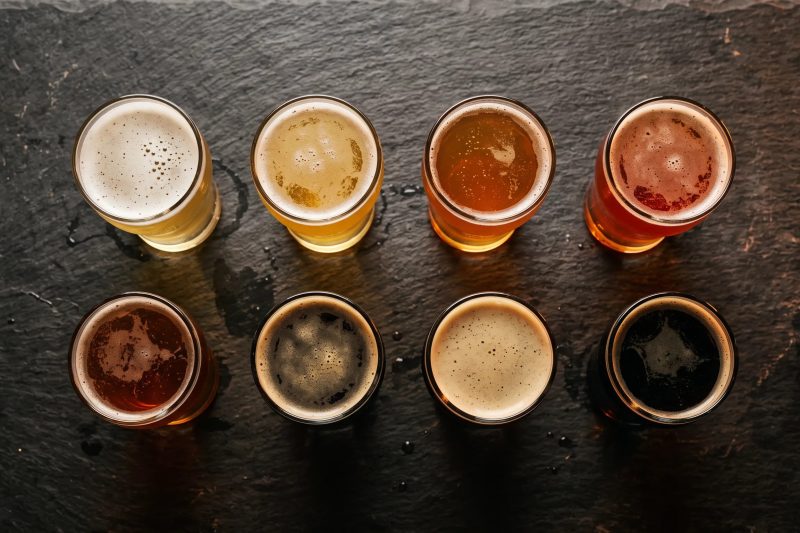
Appearance: Clear to brilliant golden or amber. Clarity is a feature, not an absence of quality — a West Coast IPA should be visually crisp.
Aroma: Hop-forward with citrus (grapefruit, orange, lemon), pine, resin, and sometimes floral or herbal notes from American hop varieties like Cascade, Centennial, Chinook, Columbus, and Simcoe.
Flavor: Firm, clean bitterness that is sharp rather than harsh. The malt is present but not sweet — it provides structure without competing with the hops. The finish is dry, which is what allows the hop bitterness to be prominent without being punishing.
Mouthfeel: Medium body, moderate carbonation. Not thick, not thin. Clean and refreshing despite the bitterness.
ABV: Typically 6-7.5%. High enough to carry the hop character; low enough to drink more than one.
The key virtue of a great West Coast IPA is the balance between bitterness and malt. Bitterness that is sharp, clean, and dry is very different from bitterness that is harsh, lingering, or astringent. The worst West Coast IPAs mistake aggressive hopping for quality and produce beers that assault rather than please. The best ones — Pliny the Elder from Russian River, Blind Pig from Russian River, Sculpin from Ballast Point — achieve a bitterness so integrated and clean that it becomes the beer’s most appealing feature.
New England IPA — Haze, Juice, and the Vermont Revolution
The New England IPA style emerged from small Vermont breweries in the early 2010s — most notably The Alchemist (makers of Heady Topper) and Hill Farmstead — and then exploded nationally when Tree House Brewing in Massachusetts and Trillium Brewing in Boston perfected the style and attracted cult followings willing to drive hours for fresh cans.
The philosophical difference from West Coast IPA is fundamental: where West Coast IPA uses hops to produce bitterness, New England IPA uses hops to produce aroma and flavor while minimizing perceived bitterness. The mechanism involves adding hops late in the brewing process and during fermentation (dry hopping) rather than early in the boil, extracting aromatic compounds without converting them to bitter iso-alpha acids. The result is a beer that smells and tastes intensely of tropical fruit — mango, passion fruit, pineapple, guava — without the firm bitterness of a West Coast beer.
The IPA Family — Double, Session, Sour, and Beyond
What Makes a Great IPA — Balance, Freshness, and Hops
Three things separate great IPAs from merely hoppy ones: balance, freshness, and hop quality. None of the three is sufficient alone.
The Three Variables That Make or Break an IPA
Balance: The hops are the feature; the malt is the foundation. A great IPA has enough malt character to give the hops something to work against — not sweet, not dominant, but present. Without the malt foundation, even the finest hops produce a harsh, one-dimensional beer. Bitterness that is clean and sharp is the result of balance; bitterness that is harsh, soapy, or lingering is the result of its absence.
Freshness: IPA is more sensitive to age than almost any other beer style. The volatile aromatic compounds that give IPA its characteristic citrus, pine, tropical fruit, and resin character begin degrading from the moment the beer is packaged. A hazy IPA older than six to eight weeks loses most of what makes it worth drinking. West Coast IPA holds up somewhat longer but rewards freshness too. The date on the can is not a suggestion.
Hop quality: Not all hops are equal, and not all hop additions are timed correctly. High-quality hops added at the right moment in the brewing process — late boil additions for aroma, dry hopping for intense volatile aromatics — produce the depth of hop character that separates good IPAs from great ones. Excessive early-boil hopping produces bitterness without aroma; excessive dry hopping without the right timing produces aroma without integration.
IPA in 2026 — West Coast Comeback and IPA Fatigue
The phrase “IPA fatigue” is appearing in taproom conversations and beer industry forums in 2026 with increasing frequency. After a decade of hazy dominance — double dry-hopped NEIPAs in infinite tropical fruit variations — a segment of the craft beer drinking public is ready for something different. The irony is that “something different” turns out to be West Coast IPA, the style that dominated craft beer before haze arrived.
For drinkers over 40 who grew up with West Coast IPA, the style’s resurgence is a welcome return. For drinkers under 35 who discovered craft beer in the hazy era, West Coast IPA is genuinely new — the firm bitterness, the clarity, the piney resin character are things they haven’t encountered in a style they thought they knew. Industry observers are noting the shift: menus that were all-haze are adding West Coast options; breweries that built their reputation on NEIPA are releasing clear, bitter IPAs alongside their hazy flagship.
The hazy IPA is not going anywhere. The Alchemist, Tree House, Trillium, and Hill Farmstead remain destinations for serious drinkers, and the style continues to evolve with experimental hop varieties like Sabro, Idaho 7, and HBC 630 pushing the tropical fruit character in new directions. What is changing is the monopoly — the sense that IPA meant hazy and bitter meant old-fashioned. The most interesting IPA moment in a decade is the recognition that both styles are great, they are just great in different ways, and a taproom that offers both is more interesting than one that offers only one.
Frequently Asked Questions About IPA