Barleywines are the best of pale malts
After a break for the Christmas season, the Untappd Challenge is back for the new year. Untappd is a free social drinking app that allows you to check in and rate your way through the craft beer world. Along the way, there are badges you can shoot for that help guide your craft beer experience. I’ve done about one per month since last January, so here is your 12th badge “Wine of Beer”: Check into the app with five barleywine beers. Find me on Untappd at jriley919 to show me how far you’ve come this year.
Barleywines have one of the more interesting histories among beer legend.
“Barleywine is a vestige of ancient strong ales but more recently of English parti-gyle brewing that was employed through the 19th century,” wrote Per K. Florian Kemp on “All About Beer” magazine’s website. Parti-gyle is a method when brewers make two beers from one mash, with the initial one being the strongest.
“The hodgepodge of beers had an assortment of names, with the strongest going by names such as stock (for blending), old (well-aged) or strong ale,” Kemp added.
CrushBrew Editorial · Beer Styles · 7 min read
It’s called barleywine. It contains no grapes. It is emphatically a beer. And yet it sits in the same alcohol range as table wine, ages in the cellar for years like a fine Bordeaux, gets poured into a snifter at cellar temperature, and pairs better with a cheese board than a stadium hot dog. Barleywine is the beer style that refused to stay in its lane — and that’s exactly what makes it worth understanding.
In This Article
What Is Barleywine?
Barleywine is a strong ale — brewed from grain, fermented with yeast, served in a pint glass’s stylish older sibling — that earns the “wine” in its name through sheer alcoholic strength and the complexity that strength makes possible. At 8–12% ABV, barleywine sits comfortably in table wine territory, and the best examples share wine’s other defining quality: the ability to develop and improve with age over years or even decades.
It is not a hybrid. There are no grapes. The name is a provocation — a declaration that beer, made from barley and hops and water and yeast, can reach the same heights of complexity and cellaring potential that wine drinkers have long claimed as their exclusive territory. For beer and wine drinkers alike, barleywine is the style that makes that case most compellingly.
Definition
Barleywine
A strong ale style typically ranging from 8% to 12% ABV, brewed with a high-gravity wort produced from large quantities of malted barley. Barleywine is characterized by intense malt complexity — caramel, toffee, dark fruit, and sometimes sherry-like notes in aged examples — balanced by varying degrees of hop bitterness depending on whether the style is English (restrained hops, malt-forward) or American (aggressive hops, bitter and bold). The Beer Judge Certification Program (BJCP) and the Brewers Association each recognize English barleywine and American barleywine as distinct style categories. In the UK the term is spelled as two words — barley wine — while in the US it is almost universally written as one word, largely because early American producers avoided the word “wine” on beer labels to prevent regulatory confusion.
Where Does Barleywine Come From?
The roots of barleywine reach back to 18th-century England, where brewers used a technique called parti-gyle brewing to extract maximum value from a single grain mash. The method works like this: a brewer would load a mash tun with a massive quantity of malt, then draw off the liquid in multiple passes. The first runnings — the richest, most sugar-dense liquid — produced the strongest beer. Subsequent runnings produced progressively weaker ones. Think of it as brewing espresso, then using the same grounds to make a second and third pot: the first extraction is the most intense.
Definition
Parti-Gyle Brewing
A historical brewing method in which two or more beers of different strengths are produced from a single mash by drawing off successive runnings of wort. The first running contains the highest concentration of fermentable sugars and produces the strongest beer; later runnings yield progressively weaker beers. Parti-gyle was the dominant English brewing method before sparging — the practice of rinsing the grain bed with hot water to extract additional sugars — became widespread. In parti-gyle brewing, barleywine was the premier product: the richest first running, set aside to ferment slowly, age in barrels, and develop the complexity that gave it its wine-like character. The method explains both why barleywine is so strong and why it was historically expensive — it consumed enormous quantities of malt to produce a relatively small volume of beer.
Those first runnings, aged in wooden barrels through the winter, developed caramel, fruit, and sherry-like notes over months and years — complexity that could genuinely rival the imported wines that Britain’s aristocracy favored. The style acquired several names — stock ale, old ale, strong ale — before Bass Brewery in Burton-on-Trent formalized the marketing around 1870 by calling its No. 1 Ale a barleywine. The name was pure commercial genius: it signaled strength, quality, and aging potential to consumers who understood exactly what wine implied.
The style crossed the Atlantic nearly a century later. In 1976, Anchor Brewing Company in San Francisco introduced Old Foghorn Barleywine Style Ale — deliberately written as one word and labeled “barleywine style” rather than “barleywine” to pre-empt any regulatory objection to the word “wine” appearing on a beer label. It was the first American barleywine. Sierra Nevada Bigfoot followed in 1983 and became the style’s defining American expression, winning three gold medals at the Great American Beer Festival and remaining the most widely distributed barleywine in the country today.
What Is the Difference Between English and American Barleywine?
The two styles share a foundation — high alcohol, intense malt, full body — but diverge significantly in how they balance those qualities. The Beer Judge Certification Program and the Brewers Association both recognize them as distinct categories, and the difference is significant enough that drinking one without knowing the other exists gives you a genuinely incomplete picture of what barleywine can be.
If you enjoy the rich, malt-forward complexity of a fine Scotch whisky or an aged Port, English barleywine is your entry point. If your palate runs to West Coast IPAs and you want something bigger, bolder, and more challenging, the American style will meet you where you are. Neither is the “correct” barleywine — they are genuinely different expressions of the same foundational idea.
What Does Barleywine Taste Like?
The dominant first impression is malt — intense, layered, and rich in a way that few other beer styles achieve. Caramel and toffee are the most commonly cited descriptors, followed by dark dried fruits (raisins, figs, plums), molasses, and sometimes a bread-like or biscuit quality from the grain itself. In aged examples, especially English versions, sherry-like and vinous notes emerge as the beer oxidizes slowly in the bottle.
Alcohol warmth is present — at 10% ABV you will feel the heat — but in a well-made barleywine it is soft rather than harsh, coating the palate rather than burning it. The mouthfeel is full and sometimes viscous; this is not a refreshing beer in any conventional sense. It is a contemplative one.
Key Concept
Original Gravity and High-Gravity Brewing
Original gravity (OG) measures the sugar concentration of wort before fermentation — a direct indicator of how much alcohol the finished beer will contain and how much residual malt sweetness will remain. Barleywine is brewed from wort with exceptionally high original gravity, often exceeding 1.080 (compared to 1.040–1.055 for a typical pale ale). Achieving this requires using very large quantities of malt in the mash — significantly more grain per volume of water than a standard beer. The high sugar content not only drives alcohol production but leaves residual sweetness that gives barleywine its characteristic richness. This is why barleywine is both expensive to produce and why it can age so well: there is substantial structure — alcohol, malt sugars, and hop bitterness — to support the beer through years of development.
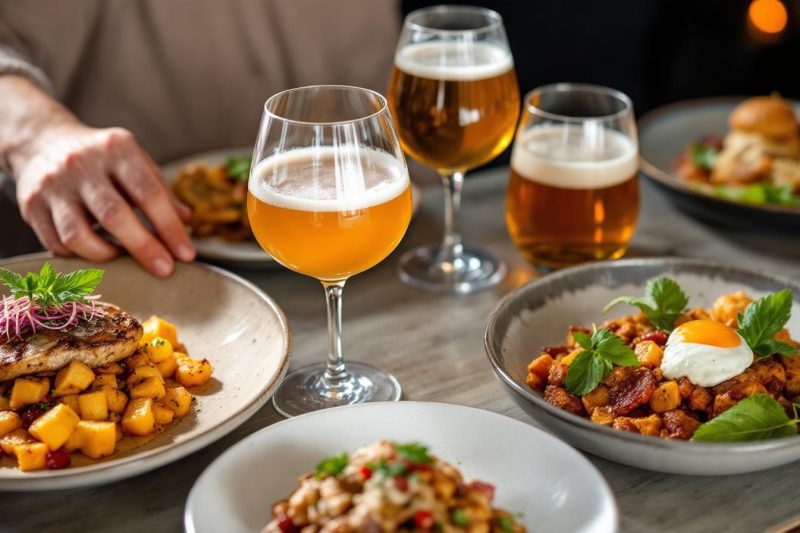
Food pairing follows naturally from the flavor profile. Barleywine’s intensity demands equally bold partners: strong blue cheeses (Stilton is the classic English match), aged hard cheeses, dark chocolate, game meats, braised short ribs, or rich desserts like toffee pudding and carrot cake. It also works beautifully as a digestif on its own — a small pour in a snifter after a meal, the way you might approach a Cognac or aged Scotch.
How Do You Serve and Age Barleywine?
Barleywine is one of the very few beer styles where serving temperature, glassware, and the decision of when to drink all matter significantly to the experience — much like wine.
Sierra Nevada Bigfoot is the textbook American barleywine cellaring experiment. Many enthusiasts buy a six-pack annually and open bottles every six months over several years. The same beer that is aggressively hoppy and almost too bitter when fresh becomes a rich, malt-sweet, nuanced sipper three to five years later. The hops don’t disappear — they integrate.
Which Barleywines Should You Try?
The barleywine category ranges from widely distributed national releases to highly sought limited annual drops. The list below covers both the accessible entry points and the benchmarks worth seeking out.
Frequently Asked Questions About Barleywine
🍺 English vs. American Barleywine — Quick Reference
The two styles at a glance — for when you’re standing in front of a beer shelf trying to decide
Characteristic English Barleywine American Barleywine Typical ABV 8–12% 8.5–12%+ Dominant character Malt — toffee, dark fruit, sherry Malt + aggressive hops — citrus, pine, resin Hop profile Restrained; English varieties — earthy, floral Bold; American varieties — Cascade, Centennial, Chinook Color Deep amber to brown Amber to copper, sometimes red highlights Best served Snifter, 50–55°F, as digestif or with cheese Snifter, 50–55°F, with bold food or on its own Cellaring Develops sherry, dried fruit, vinous depth over years Hops integrate and fade; malt sweetness emerges over 1–3 years Good for wine drinkers? Yes — closest beer style to aged Port or dessert wine With age — fresh American barleywine can be aggressively bitter Benchmark examples Goose Island BCS Barleywine, Fox Farm Copestone Sierra Nevada Bigfoot, Great Divide Old Ruffian, Revolution Straight Jacket