CrushBrew Editorial
Wine tasting has a reputation for being intimidating — all those swirling glasses and hushed pronouncements about “barnyard notes” and “wet stones.” Most of it is theater. The actual practice of tasting wine deliberately — paying attention to what you see, smell, and taste rather than just drinking it — is a genuinely useful skill that makes wine more enjoyable, helps you communicate what you like to a sommelier or wine shop, and makes you a better shopper. It takes about ten minutes to learn the basics. Here’s how it works.
◆Tasting wine deliberately makes it more enjoyable — not more pretentious — Paying attention to what you smell and taste trains your palate over time. You’ll start noticing differences between wines you would previously have called “just red” or “just white,” and you’ll be able to articulate what you like, which makes buying wine significantly easier.
◆The four steps are look, swirl, smell, taste — in that order — Each step builds on the last. What you see prepares you for what you’ll smell; what you smell prepares you for what you’ll taste. Rushing to the drinking part skips most of the information the wine is offering.
◆Your nose is more important than your palate — Most of what we perceive as “flavor” is actually aroma — detected by your nose rather than your tongue. Your tongue detects only five basic tastes: sweet, sour, salty, bitter, and umami. Everything else — the blackberry, the vanilla, the cedar — comes through smell. The swirl step exists entirely to help your nose do its job.
◆Temperature matters more than most people realize — Red wine served too warm tastes alcoholic and flat. White wine served too cold loses its aromatics. The general guidelines: full-bodied reds at 60–65°F (not room temperature, which is usually warmer); light reds at 55–60°F; whites and sparkling at 45–50°F.
◆There are no wrong answers about what you taste — Professional wine descriptors exist to communicate, not to test you. If a wine makes you think of dried cherries and pencil shavings and that’s exactly what the person next to you calls “red fruit and cedar,” you’re describing the same thing in different words. The goal is accuracy about your own experience, not conformity to a standard vocabulary.
In This Article
Step 1: Look — What Color Tells You
Hold your glass up to a light source, or tilt it against a white background (a napkin or tablecloth works well), and take a moment to look at the wine before doing anything else. You can extract a surprising amount of useful information from color alone.
What Color Reveals
Depth of color — A deeply colored red suggests fuller body, more tannin, and richer flavors. A paler red (common in Pinot Noir and Gamay) suggests lighter body and more delicate character. In white wine, pale straw indicates a lighter, crisper style; deeper gold suggests more body or oak aging.
Color at the rim vs. the center — Tilt the glass and look at where the wine meets the glass at the edge (the rim). In young red wines, the rim is usually a similar color to the center — vivid ruby or purple. In older reds, the rim begins to show brick or orange tones while the center remains deeper. This rim color is one of the easiest visible indicators of a wine’s age.
Clarity — Most commercial wines are clear and bright. Cloudiness or haziness can indicate natural (unfined/unfiltered) wine, which is increasingly common and not a flaw. Occasional small crystals at the bottom of a white wine bottle are tartrate crystals — a natural harmless byproduct of cold temperatures and a sign the wine is minimally processed.
Step 2: Swirl — And Why It Matters
Swirling is the step that looks most affected from the outside and has the most practical purpose. When wine sits still in a glass, its aromatic compounds are largely trapped at the surface. Swirling coats the inside of the glass with a thin film of wine, dramatically increasing the surface area of wine exposed to air — and dramatically increasing the amount of aroma that reaches your nose in the next step.
The technique: hold the glass by the stem (not the bowl — your hand will warm the wine and smudge the glass) and make small circular motions with your wrist. You don’t need theatrical full-arm swirling; a gentle rotation is sufficient. If you’re nervous about splashing, keep the base of the glass on the table while swirling.
The Legs (Tears) of Wine
What those drips down the glass actually tell you
After swirling, you’ll notice droplets of wine slowly running down the inside of the glass — commonly called “legs” or “tears.” These are caused by the interaction of alcohol and water, not by glycerol or quality as is commonly believed. Wines with more alcohol tend to show more pronounced legs. What legs do not tell you: quality, body, or sweetness. They’ve been the source of more wine mythology than almost any other visual element, and the honest answer is that they don’t tell you much that’s useful beyond approximate alcohol level.
Step 3: Smell — The Most Important Step
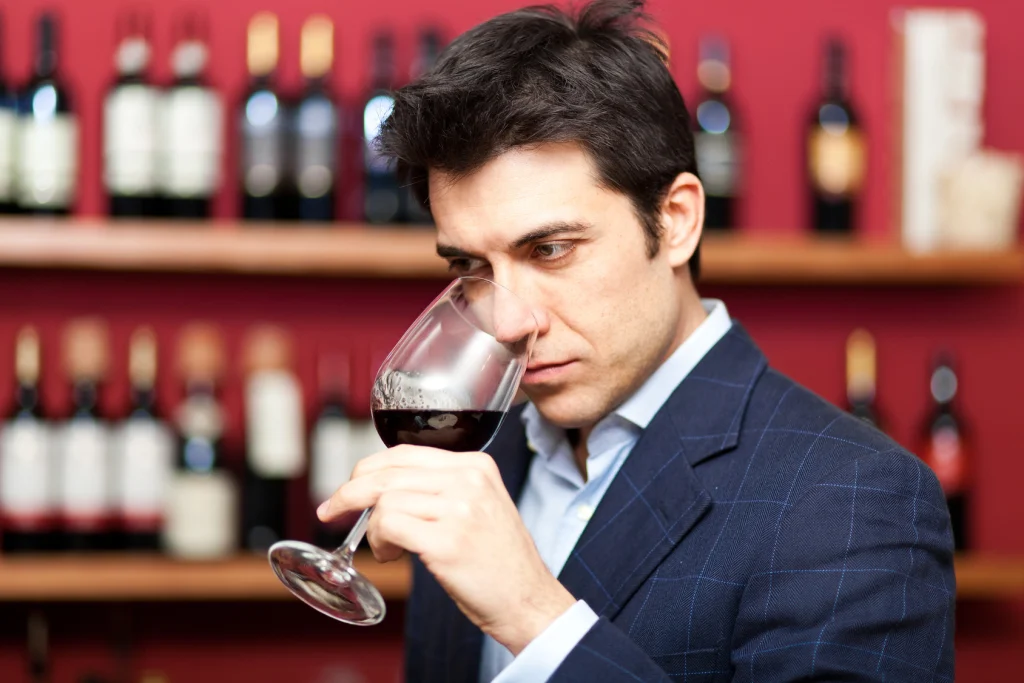
This is the step most people rush past, and it’s the most important one. Put your nose directly into the glass — don’t hover above it — and take a few short sniffs rather than one long inhale. Short sniffs are more effective at detecting aromatic compounds; a long single inhale tends to saturate your olfactory receptors and reduces sensitivity. After a few sniffs, give the wine another gentle swirl and try again. The second smell often reveals something the first didn’t.
What you’re looking for isn’t the ability to name specific scents precisely — it’s to build a general picture of the wine’s character. Is it fruity or earthy? Light and fresh or deep and rich? Do you notice anything floral? Anything spicy? Anything that smells like it came from the cellar (wood, vanilla) versus the vineyard (fruit, earth)? These impressions will prepare you for what you taste.
Common Aroma Families — What to Look For
Fruit — The most common category. In red wines: red fruit (cherry, strawberry, raspberry) suggests lighter body; dark fruit (blackberry, plum, blueberry) suggests fuller body. In white wines: citrus (lemon, grapefruit) indicates crispness; stone fruit (peach, apricot) suggests more richness; tropical fruit (mango, pineapple) is common in warmer-climate whites.
Earth and savory — Soil, mushroom, leather, tobacco, meat. More common in Old World wines (French, Italian, Spanish) than New World. These aren’t off-notes; in many wines they’re considered marks of complexity and terroir. If a wine smells of pencil shavings, wet earth, or a forest floor, those are likely intentional characteristics.
Oak and cellar — Vanilla, toast, coconut, cedar, smoke, butter. These come from oak barrel aging. New oak contributes more of these flavors; older, neutral barrels contribute less. Wines made in stainless steel tanks have none of these characteristics. Neither approach is inherently better — they produce different styles.
Floral — Violet, rose, lavender, orange blossom. Common in Viognier, Gewürztraminer, and some Grenache-based reds. Often a positive quality marker when integrated with the wine’s other aromas rather than dominating.
If a wine smells vinegary (sharp, biting acetic acid aroma), it may have turned. If it smells musty or like damp cardboard, it may be “corked” — contaminated by a chemical compound called TCA that comes from a faulty natural cork. Both are wine faults rather than stylistic choices, and most restaurants and wine shops will replace a bottle that is clearly faulty.
Step 4: Taste — What to Pay Attention To
Take a small sip and let it sit in your mouth for a few seconds before swallowing. You don’t need to make dramatic gargling sounds — just let the wine coat your palate and notice what’s happening. You’re evaluating several things simultaneously:
What to Notice When Tasting
Sweetness — Does the wine taste sweet (residual sugar), or is it completely dry (no perceptible sugar)? Most table wine is dry or nearly dry. Sweetness is detected immediately, on the tip of the tongue.
Acidity — Does your mouth water? High acidity (common in Sauvignon Blanc, Riesling, Pinot Noir, Italian reds) makes your mouth salivate. This is what makes wines feel “crisp” or “fresh.” Low-acid wines feel rounder and softer. Acidity is what makes wine food-friendly — it cuts through fat and salt the same way lemon juice does.
Tannin — In red wines only: does your mouth feel dry and slightly grippy, especially along the gums and inner cheeks? That’s tannin — a natural compound from grape skins and seeds that provides structure and aging potential. Highly tannic wines (young Barolo, Cabernet Sauvignon) feel more astringent; low-tannin wines (Pinot Noir, Gamay) feel smoother.
Body — Does the wine feel light (like water) or full (like whole milk) in your mouth? Body is mostly a function of alcohol level and sugar — fuller-bodied wines tend to have higher alcohol and more richness. A Pinot Grigio is light-bodied; a Napa Cabernet is full-bodied.
Finish — After you swallow, how long do the flavors linger? A wine with a “long finish” continues to reveal flavor for 30 seconds or more after swallowing. A short finish fades almost immediately. Longer finishes are generally associated with higher quality, though this isn’t a rule without exceptions.
Temperature, Glassware, and Serving Basics
“Red wine at room temperature” is a guideline that was developed in European cellars where room temperature was around 60°F. In a modern heated home or restaurant, room temperature is often 70°F or warmer — too warm for most red wine, which will taste flat and alcoholic at that temperature. Put a red wine in the refrigerator for 20 minutes before serving and you’ll notice the difference.
Serving Temperature Guidelines
Sparkling wine (Champagne, Prosecco, Cava): 40–45°F — coldest of all styles; the bubbles integrate better and the wine feels more refreshing at lower temperatures.
Light whites and rosé (Pinot Grigio, Sauvignon Blanc, Riesling, most rosé): 45–50°F — cold but not ice cold; these wines lose their delicate aromas when over-chilled.
Full-bodied whites (oaked Chardonnay, Viognier): 50–55°F — slightly warmer allows the wine’s complexity to open up.
Light reds (Pinot Noir, Gamay, Barbera): 55–60°F — a light chill brings out freshness and fruit character in lighter reds.
Full-bodied reds (Cabernet Sauvignon, Syrah, Barolo): 60–65°F — below room temperature in most homes; 20 minutes in the refrigerator before serving is usually sufficient.
On glassware: you don’t need a different glass for every grape variety, but a few basics help. For red wine, a larger bowl allows more swirling and more aromatic development. For white wine and sparkling, a narrower glass preserves temperature longer. For sparkling wine specifically, a flute preserves the bubbles but limits aroma — if you want to actually taste a good Champagne, a white wine glass works better.
Fill the glass to about one-third to half full — not more. Leaving space in the glass is what allows you to swirl without spilling, and gives the wine’s aromatics room to gather.
Wine Vocabulary Demystified
Wine has a reputation for impenetrable vocabulary, and some of it is genuinely unhelpful. But a small core vocabulary covers most of what you’ll encounter in tasting notes and wine shop descriptions:
Core Wine Terms You’ll Actually Use
Varietal — A wine made from a single grape variety, typically labeled by that grape name (Chardonnay, Merlot, Pinot Noir). Most New World wines (US, Australia, Argentina) are varietally labeled. Old World wines (France, Italy, Spain) are more often labeled by region.
Blend — A wine made from two or more grape varieties. Bordeaux blends (Cabernet Sauvignon, Merlot, Cabernet Franc, and others) and GSM blends (Grenache, Syrah, Mourvèdre) are classic examples. Blending is a winemaking choice, not a marker of lower quality — Champagne is almost always a blend.
Dry — A wine with no perceptible residual sugar. Almost all table wine served in restaurants is dry. “Dry” does not mean lacking in flavor or fruit; a dry wine can still taste very fruity.
Terroir — A French term encompassing everything about a wine’s origin that influences its flavor: soil composition, climate, topography, aspect (direction the vineyard faces), and local winemaking tradition. The reason a Pinot Noir from Burgundy tastes different from one grown in Oregon using the same grape.
Tannin — A naturally occurring compound in grape skins, seeds, and stems (and in oak barrels) that causes a drying, slightly astringent sensation in the mouth. High tannin wines (young Cabernet, Barolo) feel grippy; low tannin wines (Pinot Noir, Pinot Grigio) feel smoother. Tannins soften with age, which is why tannic wines are often cellared.
Sparkling wine vs. Champagne — Champagne is sparkling wine produced in the Champagne region of northeastern France using the traditional method (secondary fermentation in the bottle). All other sparkling wines — Prosecco (Italy), Cava (Spain), Crémant (France, outside Champagne), American sparkling wine — are sparkling wines, not Champagne, regardless of how they’re labeled.
Frequently Asked Questions About Wine Tasting
Wine Tasting: Common Questions Answered
Why do you swirl wine before smelling it?
Swirling coats the inside of the glass with a thin film of wine, dramatically increasing the surface area exposed to air. This accelerates evaporation of the wine’s aromatic compounds — the molecules responsible for what you smell — into the space above the liquid where your nose can detect them. Without swirling, many of those aromatic compounds remain trapped at the wine’s surface. The step takes three seconds and makes the subsequent smell significantly more informative.
What does it mean when a wine is “corked”?
A corked wine has been contaminated by a chemical compound called TCA (2,4,6-trichloroanisole), which develops in natural cork that has been exposed to certain molds and chlorine compounds. The result is a wine that smells musty, like wet cardboard or a damp basement — not vinegary, not just “off,” but specifically damp and cardboard-like. A corked wine is a manufacturing defect, not something caused by improper storage, and any reputable wine shop or restaurant should replace a clearly corked bottle without hesitation.
Should I spit or swallow at a wine tasting?
At a formal tasting with many wines — a trade tasting, a large winery open house, a guided tasting event — spitting is standard practice and nothing to be self-conscious about. Spitting allows you to taste 20 or 30 wines while maintaining your ability to evaluate each one accurately. The spittoon (usually a bucket or container) is provided for exactly this purpose, and using it is what professionals do. At a casual dinner with a few bottles, swallowing is obviously the norm.
Why does wine taste different when it warms up in the glass?
Temperature significantly affects how aromatic compounds evaporate and how your palate perceives different flavor components. A wine that’s too cold suppresses aromatics — you’ll smell less and the wine may seem one-dimensional. As it warms slightly, the aromatics open up and the wine becomes more expressive. At too-warm temperatures, alcohol becomes more prominent and can overwhelm more delicate flavors. This is why serving wine at the right temperature matters, and why a wine that seems tight and closed when first poured often improves noticeably after sitting in the glass for ten minutes.
What’s the difference between a varietal wine and a blend?
A varietal wine is made primarily from a single grape variety and labeled with that grape’s name — Chardonnay, Pinot Noir, Sauvignon Blanc. In the US, a wine must contain at least 75% of the named grape to carry that varietal label. A blend combines two or more varieties, often labeled by region (Bordeaux, Châteauneuf-du-Pape) or proprietary name rather than grape variety. Blending is a winemaking choice that can produce wines of extraordinary complexity — Champagne is almost always a blend; so is most Bordeaux. Neither style is inherently superior to the other.
🍷 What Color Tells You About Wine
A quick visual guide to reading the glass before you taste
| What You See |
Likely Grape / Style |
What to Expect |
| Pale straw / light yellow |
Pinot Grigio, Sauvignon Blanc, young Riesling |
Crisp, citrusy, light-bodied; fresh and unoaked |
| Medium gold |
Chardonnay, Viognier, aged whites |
More body; possible oak aging; stone fruit character |
| Deep gold / amber |
Oaked Chardonnay, aged Riesling, orange wine |
Rich and full; significant oak or age; complex |
| Pale ruby / translucent |
Pinot Noir, Gamay, light Italian reds |
Light body, low tannin, red fruit; elegant style |
| Medium ruby / cherry red |
Merlot, Sangiovese, Tempranillo |
Medium body; mix of red and dark fruit; moderate tannin |
| Deep purple / opaque |
Cabernet Sauvignon, Syrah, Malbec |
Full body, high tannin, dark fruit; bold and structured |
| Brick / orange rim on red |
Aged red wine of any variety |
Secondary and tertiary flavors developing; tannins softening |