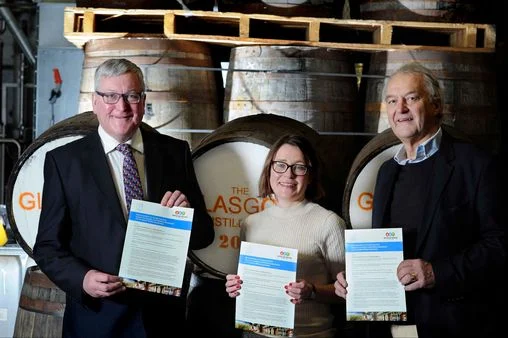
Whisky industry trade body joins forces with craft distillers to promote the true spirit of Scotch
CrushBrew Editorial · Spirits · Scotland · 7 min read
Scotland is home to 154 operating whisky distilleries as of May 2026 — nearly double the number that existed at the turn of the century. The craft spirits revolution that drove that growth is now facing its most serious test: softening global demand, rising UK alcohol duty, falling exports to key markets, and a post-pandemic hangover that has left nearly one in five Scottish distilleries in financial distress. The story of Scottish craft distilling in 2026 is not a simple boom story. It’s more complicated — and more interesting — than that.
In This Article
- How did the Scottish craft distilling boom happen?
- How do craft distilleries fit alongside Scotland’s corporate giants?
- What challenges are Scottish distilleries facing in 2026?
- What advantages do craft distilleries have that corporate producers don’t?
- What is the outlook for Scottish craft distilling?
- Frequently asked questions
- Scottish distilling — key facts at a glance
How Did the Scottish Craft Distilling Boom Happen?
At the turn of the 21st century, around 86 distilleries were operating in Scotland. By May 2026, there are 154. That growth — nearly doubling the number of operating distilleries in 25 years — represents one of the most significant structural changes in the history of Scottish whisky, a category that had been dominated for decades by a small number of corporate groups controlling hundreds of brands.
Several forces converged to make it happen. The global craft spirits movement that transformed American brewing and distilling in the 2000s eventually crossed the Atlantic, bringing with it a consumer appetite for authenticity, provenance, and small-batch production that corporate brands struggled to satisfy. The rise of premium single malt Scotch as a globally traded category — driven by demand from Asia, particularly China and India — demonstrated that whisky could command prices that justified smaller-scale investment. And the Scottish gin boom of the 2010s gave new distilleries a pathway to cash flow: gin can be produced and sold in weeks rather than years, providing the revenue that keeps the stills running while whisky matures in barrels.
Definition
Scotch Whisky
A whisky distilled and matured entirely in Scotland, subject to strict legal requirements enforced by the Scotch Whisky Regulations 2009. To qualify as Scotch Whisky, the spirit must be produced at a Scottish distillery from water and malted barley (or other whole cereal grains), matured in oak casks in Scotland for a minimum of three years, have a minimum bottling strength of 40% ABV, and retain the colour, aroma, and taste derived from the raw materials and production method. The three-year minimum maturation requirement is what fundamentally distinguishes Scotch production economics from those of gin or vodka — it creates a multi-year gap between capital investment and first revenue that defines the financial challenge for new entrants.
Between 2010 and 2020, no fewer than 31 new distilleries began operations in Scotland. These new entrants were a different breed from the corporate malt producers they joined — smaller in scale (many with capacities between 20,000 and 400,000 litres, compared to millions for the major players), focused on tourism and direct-to-consumer sales as well as wholesale, and often producing gin alongside whisky to fund the long wait for their first legal Scotch releases.
How Do Craft Distilleries Fit Alongside Scotland’s Corporate Giants?
The Scotch whisky industry has always been a study in contrasts between scale and character. Diageo, Pernod Ricard, and William Grant & Sons collectively control an estimated 40–50% of the global Scotch market. The five largest malt distilleries in Scotland each produce over 12 million litres of alcohol per annum — Glenlivet and Glenfiddich each capable of reaching 21 million. The total theoretical production capacity of all Scottish distilleries combined approaches 884 million litres per year.
Against that scale, the collective capacity of Scotland’s craft newcomers is modest. The 25 or so new distilleries founded in the 2010s have a combined capacity of roughly 11 million litres — a third of the capacity of just three large corporate distilleries (Ailsa Bay, Roseisle, and Dalmunach). In terms of volume, craft distilling is a sideshow. But that framing misses what craft actually contributes: category excitement, new consumer recruitment, geographic diversity, tourism, and the authenticity narrative that the global spirits category increasingly needs to attract younger drinkers.
Definition
Scotch Whisky Association (SWA)
The trade body representing the Scotch whisky industry, founded in 1942 and headquartered in Edinburgh. The SWA represents both large corporate distillers and independent producers, lobbying on behalf of the industry with UK and Scottish governments, protecting the Scotch whisky designation through legal enforcement internationally, promoting responsible marketing, and publishing industry statistics. With over a century of accumulated expertise in market access, legal protection of geographical indications, and export development, the SWA plays a significant role in shaping the regulatory environment within which both corporate and craft distillers operate.
The accreditation model developed by the Scottish Craft Distillers Association (now evolved into the broader Scottish Distillers Association) addresses a specific problem that craft producers face: protecting the authenticity of the “Scottish” label from producers who use Scotland’s provenance to market spirits actually distilled elsewhere. To receive accreditation, a distillery must own and operate its own still and manufacture and bottle in Scotland — requirements that draw a clear line between genuine craft production and label-only Scottish branding. That authenticity protection matters more to small producers than to corporate giants with established global brand recognition.
What Challenges Are Scottish Distilleries Facing in 2026?
The industry that looked unstoppable in 2021 is navigating its most difficult conditions since the 1980s whisky loch. According to restructuring firm BTG, nearly one in five Scottish distilleries — 69 in total — were facing significant or critical financial issues as of December 2025, a 40.8% increase in distress in just the final quarter of the year. The causes are multiple and mutually reinforcing.
Key Concept
The Whisky Lake
Industry shorthand for a period of significant oversupply in Scotch whisky — when the volume of maturing stock exceeds foreseeable demand, depressing prices and putting financial pressure on producers. The original “whisky loch” of the 1980s followed aggressive overproduction in the 1970s boom years and led to widespread distillery closures. Today’s industry analysts are watching carefully for signs that the production expansion of the 2010s has created a new structural oversupply problem, compounded by the demand softening of 2023–2025. The minimum three-year maturation requirement makes course-correction difficult once overproduction has occurred.
What Advantages Do Craft Distilleries Have That Corporate Producers Don’t?
The pressures facing small Scottish distilleries are real — but so are their structural advantages. Corporate giants like Diageo and Pernod Ricard are optimized for volume, consistency, and global distribution. Their strengths become vulnerabilities when the market wants the opposite: variability, authenticity, access, and story.
Craft distilleries are nimble in ways that multinationals structurally cannot be. They can produce multiple small-batch SKUs in rapid succession, responding to consumer trends — a peated expression one season, an experimental cask finish the next — where a corporate operation requires years of planning and minimum viable volumes that make small-batch experimentation impractical. They can build direct relationships with consumers through tasting rooms and visitor experiences that their large-scale counterparts increasingly struggle to make feel authentic at the scale required.
The distilleries thriving through the current downturn share several characteristics: they entered the market with realistic cash flow models rather than optimistic demand projections; they built revenue streams from gin, tourism, and direct sales that didn’t depend solely on whisky wholesale; and they kept overhead lean enough to survive the long maturation cycle before their first legal Scotch releases could generate meaningful income.
What Is the Outlook for Scottish Craft Distilling?
The near-term picture is genuinely difficult. Rising duty, softening demand, export market uncertainty, and the structural challenge of whisky’s long production cycle are all real constraints that will not resolve quickly. Some craft producers will not survive — and the ones that don’t will be among those who overextended during the boom years without adequate cash flow reserves to weather the contraction.
But the medium-term structural case for Scottish craft distilling remains solid. Global demand for premium Scotch is forecast to grow — Euromonitor projects Scotch volumes up 1.38% in 2025 and a further 1.85% in 2026 — even if the pace is slower than the boom years suggested. Asia Pacific, despite the China setback, remains the most valuable export region at £1.57 billion in 2024 and continues to develop. The premiumisation trend — consumers spending more per bottle on higher-quality, more distinctive products — disproportionately benefits craft producers whose entire proposition is premium and distinctive.
The industry’s long-term health depends significantly on how it handles the tension between craft’s authenticity promise and the inevitable commercial pressures to scale. The distilleries that hold their nerve — maintaining quality, building genuine consumer relationships, and surviving the cash flow challenge of whisky’s maturation cycle — will be positioned well when demand recovers. The ones that stretched too far, too fast will provide a cautionary tale for the next wave of new entrants that will inevitably follow.
Frequently Asked Questions About Scottish Craft Distilling
🥃 Scottish Distilling: Key Facts at a Glance
Current industry statistics, economic impact, and the craft vs. corporate landscape
| Metric | Figure | Source / Notes |
|---|---|---|
| Operating distilleries in Scotland | 154 | Scotch Whisky Association, May 2026 |
| Distilleries in 2000 | ~86 | Nearly doubled in 25 years |
| Jobs supported in Scotland | 41,000+ | SWA; 24,000 created in past decade |
| GVA contribution to UK economy | £7.1 billion | SWA, 2022 figure |
| Share of Scotland’s goods exports | 23% | SWA, 2025; 77% of all Scottish food & drink exports |
| Distillery tourism visits | 2.7 million | 2024; largest tourist attraction category in Scotland |
| Distilleries in financial distress | 69 (19%) | BTG Red Flag Alert data, December 2025 |
| China export decline | -30% | 2024 vs prior year; to £161 million |
| Minimum maturation for Scotch | 3 years | In oak casks in Scotland; avg. 5–6 yrs for premium |
| Casks currently maturing in Scotland | 22 million | ~12 billion 70cl bottles equivalent; SWA |