Il Palagio Vineyard – A Piece of Paradise in Firenze, Italy
CrushBrew Editorial · Wine & Travel · 9 min read
There’s a 16th-century estate on a hillside in Tuscany’s Chianti Colli Fiorentini, and it belongs to Sting and Trudie Styler. You may know it peripherally — as the rumored backdrop for an extravagant celebrity life. The truth, as usual, is more interesting. Il Palagio is a working biodynamic farm: wines and olive oil and honey, meticulously tended, the subject of serious wine press attention, and a reflection of nearly three decades of genuine commitment to the land. This is the story of how it happened — and a tasting note for the wine that first got our attention.
Key Takeaways
Il Palagio is a serious estate, not a vanity project — acquired in 1997 by Sting and Trudie Styler, the 865-acre Tuscan property has been biodynamically farmed since the early 2000s under the guidance of world-renowned viticulturist Alan York, and now produces wines that consistently earn strong scores in the wine press and appear on restaurant wine lists across Italy and beyond.
The estate’s wines are named for Sting songs — “Message in a Bottle,” “Sister Moon,” “Sacred Love,” “When We Dance.” The naming is playful, but the wines themselves earn independent attention: Il Palagio appears at Rome’s three-Michelin-starred La Pergola.
Trudie Styler drove the restoration — she searched seven years for a property and found one that had fallen into decline after its noble owners could no longer sustain it. The restoration of vineyards, olive groves, and farm buildings took years of hands-in-the-dirt work that continues to this day.
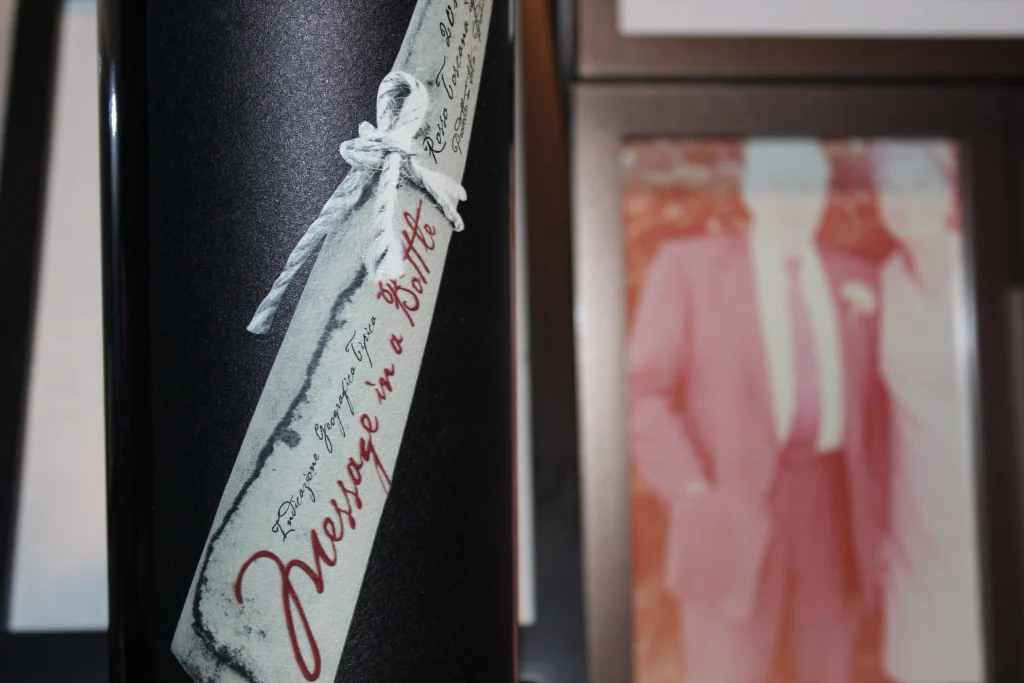
“Message in a Bottle” is the entry-level red — a Sangiovese-forward Toscana IGT blend, first released in the 2011 vintage and continuing in current production. Concentrated, elegant, and designed for the table.
The honey and olive oil are worth the same attention as the wine — over 80 beehive colonies on the property, with named honey varieties including Chestnut, Forest, and Thousand Flowers; olive oil from centuries-old trees awarded Tre Foglie (the maximum recognition) by Slow Food Italia and Gambero Rosso.
In This Article
A Different Kind of Resonance
The first time I can remember ever consciously listening to a band — not just listening to music — I was sitting by the radio in the kitchen waiting for “Every Breath You Take,” “Wrapped Around Your Finger,” and “King of Pain.” It was 1983, I was 12 years old, and this was some of the most passionate sound I had ever heard. I became, through the Synchronicity album, a fan of The Police.
Very little changed two years later when Sting began his solo career: he moved through jazz to Celtic to Spanish-influenced work, was recognized for contributions to classical music, and I followed along through all of it — through the hormone-driven metamorphosis from pre-teen through angsty teenager and on into young adulthood. All of those genres found me at one point or another.
Now, sitting in my second-floor office at home — two decades later, children playing loud enough downstairs that I’m wearing headphones — I find I’ve once again discovered resonance with Sting’s work. But this resonance is with music of a different nature: wine.
I recently read that Sting has told his children they shouldn’t count on a fat inheritance to sustain them when he departs; he and wife Trudie plan on spending it all. One’s thoughts instinctively turn to the “musician lifestyle” — the idea that this couple must be burning through an estimated fortune of $300 million in nightclubs with rare Champagne, bathing in pools of rubies, wearing golden underwear. You’d have to do all of that, and more, to spend $300 million, right?
But try as I might, I cannot imagine Sting practicing Jivamukti yoga after umpteen bottles of bubbly. Nor can I picture the couple who have helped raise over $25 million for the Rainforest Foundation Fund wearing gold-plated anything. The truth is actually more spectacular than even I could have dreamt: Trudie and Sting have invested a significant portion of their wealth in the renovation and rejuvenation of a heritage estate in Tuscany. Il Palagio.
The Estate: What Il Palagio Is and How It Was Found
The word “estate” conjures images of a decadent lifestyle — too much tennis and wine, too little hard work and callouses. That image may have been accurate in the past, when Il Palagio was home to Tuscan nobility. There were lavish meals, many bottles of wine, and yes, there is still a tennis court. But with changes in a global economy, the noble family who owned the land up to 1997 was forced to sell off pieces of the property, foregoing maintenance on buildings across what had originally been 800-plus acres. The gem of Figline Valdarno — the local town, now part of Figline e Incisa Valdarno — was becoming dated and faded.
The Property
Tenuta Il Palagio
A 16th-century villa estate in the Chianti Colli Fiorentini area of Tuscany, approximately 30 kilometers south of Florence near Figline e Incisa Valdarno. The property covers approximately 350 hectares (roughly 865 acres) of vineyards, olive groves, woodland, and farmland. Once home to a succession of Florentine noble families — including the Martelli family (who expanded the estate in 1819) and the Duchy of San Clemente — the estate fell into gradual decline before Sting and Trudie Styler purchased it in 1997. The pair have since restored the main villa, guesthouses, vineyards, and olive groves into a fully functioning organic and biodynamic farm and wine estate.
It was Trudie who found the property — or, if you want to be metaphysical about it, the property that found her. She had spent seven years searching for a patch of land that could offer rest to a family that sometimes worked seven days a week for months at a stretch. (Sting’s reunion tour with The Police in 2007 alone lasted fifteen months.) Trudie wanted a hidden corner where the family could find solace and give something back to the land.
What she found was an estate with ancient olive trees, neglected vineyards, and an almost visceral sense of place. When the couple first tasted wine from the property — poured by the departing Duke — they were impressed enough that it influenced their decision to buy. Later, when the estate’s manager gently informed Sting that the Duke’s wine had actually been from France, it became the motivation to transform what they had into something worthy of the land. They brought in biodynamic viticulture pioneer Alan York to assess the vineyards. York told them that cleaning the soil and applying biodynamic systems would energize the entire property. They agreed. The work has never stopped since.
Today Il Palagio produces a range of wines under biodynamic certification, with current winemaking overseen by renowned Italian oenologist Riccardo Cotarella (who joined the estate in 2020, following Alan York’s legacy), alongside resident oenologist Ettore del Lupo. The wine appears at Rome’s three-Michelin-starred La Pergola. It sells in the UK, the US, and across Europe. The wine names — “Message in a Bottle,” “Sister Moon,” “Sacred Love,” “When We Dance,” “Casino delle Vie” — are playful references to Sting’s catalogue, but the wines themselves earn their own standing.
Honey, Olive Oil, and What Biodynamics Means at Il Palagio
I could talk about the honey for another thousand words — and that’s without having tasted it. Trudie Styler spearheaded the establishment of over 80 beehive colonies on the property. The resulting honey is sold through the estate in small-lot batches with individual flavor identities: “Chestnut,” “Forest,” “Thousand Flowers.” People gladly pay close to $10 for a jar. Some will say the name attached to the label is why. I’d respectfully disagree.
A poor product with a significant name is inevitably doomed to failure — and makes the famous person attached look foolish. Locals and tourists alike line up to buy from Il Palagio for the same reason their predecessors did hundreds of years ago: because the products are worth it. The olive oil, from 8,000 organically grown trees (some of them centuries old), has been awarded Tre Foglie by both Slow Food Italia and Gambero Rosso — the maximum recognition either organization gives to an extra-virgin olive oil. The honey, the oil, and the wine are the direct result of two people who fell in love with a hillside and its relationship to a village, and committed the resources and labor to return a fading beauty to her proper place in the community.
What It Means
Biodynamic farming at Il Palagio
Biodynamic agriculture treats the farm as a self-sustaining ecosystem — composting, cover crops, lunar planting calendars, and the complete elimination of synthetic pesticides and fertilizers. At Il Palagio, this philosophy was introduced under the guidance of Alan York, who believed that working the soil biodynamically would not only improve wine quality but re-activate the natural biodiversity of the estate. The 80-plus beehive colonies are not peripheral to this philosophy; they are central to it. Bees are essential pollinators and an indicator species for overall soil and ecosystem health. The thriving honey production at Il Palagio is evidence that the biodynamic approach is working across the entire property, not just in the vineyards.
Zig Ziglar said it: “Help enough people get what they want and you’ll get what you want.” Trudie and Sting reached out to a community, to a special place, and gave it the love and attention it needed. In doing so, they created not only a beautiful home but an anchor — meaningful work for those in the community who want it, and a connection between the land and the people who depend on it that is as old as farming itself.
Tasting Note: 2011 “Message in a Bottle” Rosso Toscana IGT
Note: This tasting note reflects the 2011 vintage, reviewed at time of release. “Message in a Bottle” continues to be produced in current vintages; the blend and style remain consistent.
It is my personal opinion that the work Trudie Styler, Sting, and the entire Il Palagio team have done to create a biodynamic, biodiverse vineyard is paying off in the glass in exactly the way you’d hope — and then some. This wine is fantastically concentrated with pure, elegant expressions of its varietals and the local terroir.
On the nose: huge aromas of wild blackberries and blueberries, musky notes of damp forest floor and wild mushrooms, and a sophisticated finish of freshly crushed black peppercorns — that last note is the Syrah speaking. The palate is fresh, clean, brisk, and alive. Medium-plus red currant and young raspberry acids work in concert with a full, fine yet chewy tannin structure to deliver flavors perfectly in sync with the bouquet. The Merlot softens the whole thing just enough to make it immediately accessible, while the Sangiovese backbone and the Syrah’s structure suggest this will continue to evolve with bottle time.
Excellent balance, structure, and concentration. This wine drinks superbly on release and rewards cellaring. The original review noted an enjoyment window of 2015–2020+; that window has now passed for the 2011, but current vintages of Message in a Bottle continue to receive strong critical attention at a price point that represents honest value for Italian Toscana IGT of this quality.
Food Pairing
A wine with this kind of dimension pairs easily with a variety of foods — and, given the ease with which it disappears in my house, needs no food at all to be thoroughly enjoyed. That said, as a chef with a wife of Calabrese descent, here is what I suggest:
Baked penne with roasted garlic, chickpeas, fresh basil, and Asiago. The wine’s bright acid will delight in the fat; the savory tones will evolve next to earthy garlic and chickpeas; the fresh basil plays against the wine’s fresh berry notes; and the salty Asiago brings the minerality back into focus. It’s a dish that mirrors the wine’s own architecture — simple elements, thoughtfully combined, producing something larger than the sum of its parts.
For something simpler: a board of aged Italian cheeses, salumi, and a handful of olives. The Sangiovese’s acidity will cut through everything; the Syrah’s pepper will match the cured meats; and you’ll be finished with the bottle before you’ve thought about it.
About the Blend
What Sangiovese + Syrah + Merlot does
Sangiovese (70%) provides the structural backbone: firm acidity, red cherry and plum fruit, a savory, slightly leathery quality that is native to Tuscany and natural in the food-pairing context. Syrah (15%) adds the darkness: black pepper, violet, roasting meat notes, and the structural tannin that gives the wine its “chewy” quality and longevity. Merlot (15%) softens and rounds the whole thing — it brings the plush, early-drinking accessibility that makes the wine approachable on release without sacrificing the depth that benefits from cellaring.
Many thanks to Maritime Wine (importer to the USA) and Il Palagio for the generous sample bottle that made this review possible.
Frequently Asked Questions About Il Palagio and “Message in a Bottle” Wine
🍷 Il Palagio / “Message in a Bottle” — Quick Reference
The essentials on the estate and the wine
| Detail | |
|---|---|
| Estate | Tenuta Il Palagio, Figline e Incisa Valdarno, Tuscany, Italy |
| Owners | Sting (Gordon Sumner) & Trudie Styler (since 1997) |
| Size | ~350 hectares (~865 acres) — vineyards, olive groves, woodland, farmland |
| Farming | Biodynamic and certified organic; introduced by Alan York |
| Winemaker | Riccardo Cotarella (consultant, since 2020); Ettore del Lupo (resident) |
| Wine production | ~120,000 bottles annually; 10+ labels named for Sting songs |
| Message in a Bottle | Sangiovese 70% / Syrah 15% / Merlot 15% · Toscana IGT · First vintage 2011 |
| 2011 review score | 91+ points · Excellent value · Benefits from 1-hour decant or aerator |
| Other products | Extra-virgin olive oil (Tre Foglie award) · Honey (80+ colonies; Chestnut, Forest, Thousand Flowers) |
| Estate website | tenutailpalagio.com |